

Type & Self
Way too meta
In Objective-C, every class is an instance of its metaclass.
What about Swift? If you've looked closely at the Swift Language Reference you'll see two short paragraphs describing SomeClass.self and SomeClass.Type, a short example (that doesn't address Type at all), and that's it.
Meta
In Swift, all . . .
Swift 2, Beta 5
Here is a quick rundown of some of the changes in Beta 5 posted today. For the full details as always check out the release notes
- Structs and classes can conform to
ErrorType - Non-failable initializers can now chain to failable initializers by using
! - Debug builds should have better performance due to using . . .
Swift Quickie: MirrorType Extension
edit: the Mirror struct now has a children property that you can indeed iterate over so this isn't really applicable anymore but the sequence stuff is still relevant. You can check out Rob Napier's post about AnySequence for more info.
I've been playing with the new reflection API in Swift 2 and found one constant . . .
Swift 2: SIMD
Single Instruction, Multiple Awesome
Swift 2 brings updated support for SIMD (Single Instruction Multiple Data). What exactly does that mean?
SIMD Primer
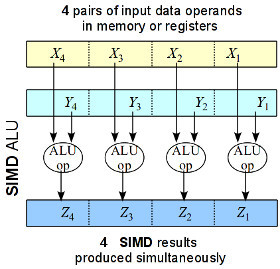
Each CPU vendor has their own unique snowflake versionº but the premise is the same: process data in parallel chunks. Each SIMD instruction operates on a group of values organized into what are . . .
Swift 2, Beta 2
Quick Recap
A quick recap for those who haven't parsed the release notes yet:
New Features
- Enum cases with values can be used as a function; basically the compiler automatically creates a function that accepts parameters matching the case's values and returns that enum case with the values filled in.
- Non-mutating . . .
Swift 2
The overview
As everyone is no doubt aware Swift 2 was announced at WWDC. I'm going to do a series of posts on the changes but for now let's just cover the major points:
General changes
- Global and free-standing functions now follow the same parameter label rules as methods. The
#external name syntax is gone. - . . .
On Being a Less Horrible Monster
Reabstraction eats the world
This is an update on a previous post.
First, @jckarter pointed out that swift_func_object is an artifact of the implementation. Swift is reabstracting the function to promote it to the most generic form (it's how a ()->Int can be passed to something expecting ()->Void). It turns out that Swift lifts functions to the . . .